Next: The impact of delay on cancer survival
Why the spread of cancer cells does not require a mutation
Equation #3 from the CORE MATH section:
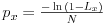
This equation provides a way to estimate the value of  from information on the fraction of patients with a manifestation of spread,
  , for a group of patients with tumors of size
  .
.
It has often been wondered whether mutation at the time of spread is a requirement for metastasis (Bernard R, Weinberg RA A progression puzzle. Nature 418:823. 2002) but, following the reasoning outlined previously, the values of the probabilities of metastatic spread of breast carcinoma, renal cell carcinoma, and melanoma cells presented here are difficult to reconcile with such genetic change: First, the value of the probability of lethal spread for the smallest melanomas (0.1 mm), at ~1 event of spread for every 500 cells, is many orders of magnitude greater than that expected for a genetic change. Second, the probability of metastatic spread per cell from the primary site declines as tumors increase in size. While this decline is consistent with a number of explanations that are mechanical, (using this term in the sense in which it is used in physics: “pertaining to the relations of force and matter”), such as the effect of tumor geometry on the escape of cells from the primary mass, it is not what would be expected for genetic events. Indeed, the probability of genetic events over time should be expected either to remain constant (if only a single genetic event is required) or to increase with time (if the accumulation of multiple genetic events is required). Third, the occurrence of one event of spread (the spread of a breast cancer cell from the breast to the local lymph nodes) does not appear to increase the probability of a second event of spread (the spread of a breast cancer cell from the local lymph nodes to the periphery). In other words, the occurrence of the initial event of spread does not lead to a cell-heritable change in the tendency of the progeny of that cell to spread. This finding indicates that the presence of cancer in the nodes is not a marker of a genetic change in the tumor, but rather simply a sign that there is more cancer from which cancer cells can emerge.